Basics
Chords: how intervals turn into a background
SMART FRET Team ·
The last article was about intervals: the distance between two notes, which is what creates a feeling in the first place. A chord is nothing but several of those intervals played at once, the background the melody moves in front of.
Once you have understood which intervals make up a chord, you do not have to memorise a thousand shapes. You know what they are made of, and you can put them together yourself when it matters.
The basis: 1, 3 and 5
The simplest chord has three notes: the 1 (the root), the 3 and the 5. This is the triad, and it is the backbone of nearly every chord you will ever grab. The 1 gives you the place you are standing. The 3 decides the emotion, bright or dark. The 5 gives the whole thing its ground, its stability.
Because both the 3 and the 5 exist in a bright and a dark version, those two switches alone give you four basic types:
| Chord type | Built from | Sounds |
|---|---|---|
| Major | 1-3-5 | bright, stable |
| Minor | 1-♭3-5 | dark, stable |
| Diminished | 1-♭3-♭5 | dark, unstable, full of tension |
| Augmented | 1-3-♯5 | bright, but floating, unresolved |
Four chord types, two switches. That is the entire difference between “sounds like a Sunday morning” and “sounds like a horror film”: two frets, no more.
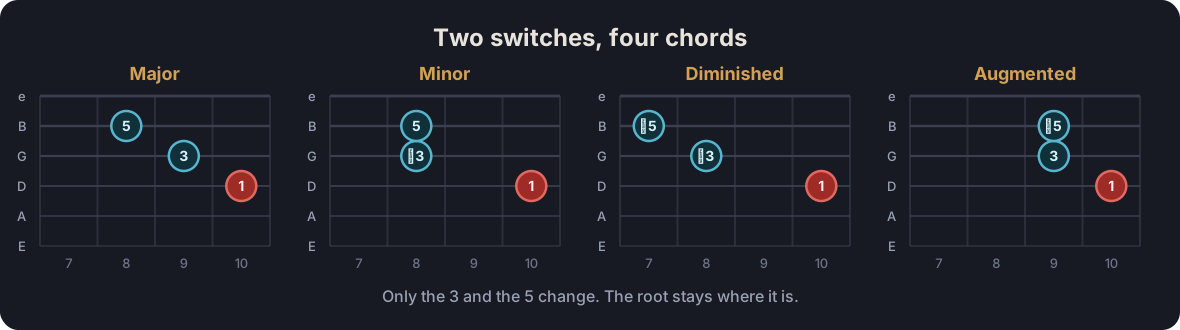
The 7: a fourth note makes the chord more complex
Add a fourth note to the triad, the 7, and you get a seventh chord. Here too there is a bright and a dark version, and here too the context the 7 lands in decides the effect.
- ♭7 on a major chord (1-3-5-♭7) gives you the dominant seventh, for example C7. It does not simply sound like “more major”, it sounds tense, almost demanding. It wants to resolve, usually to a chord a fourth higher.
- 7 on a major chord (1-3-5-7) gives you the major seventh, Cmaj7. This is the elegant, floating version, with no pull forward, more a lingering.
- ♭7 on a minor chord (1-♭3-5-♭7) gives you the minor seventh, Cm7. Softer and rounder than plain minor, less dramatic.
- 7 on a minor chord (1-♭3-5-7) gives you the minor-major seventh (mMaj7), rare, and conspicuous for exactly that reason, often heard in film scores and jazz.
- ♭7 on the diminished triad (1-♭3-♭5-♭7) gives you the half-diminished chord (m7♭5). It is already waiting for you in every key: on the seventh degree in major, and on the second degree in natural minor.
- ♭♭7 on the diminished triad gives you the fully diminished chord (dim7), the most unstable of all the standard chords.
Here too it is always the same principles being recombined: which 3, which 5, and now which 7 as well. No new chord is really new, it is a new combination of familiar switches.
The rules are a starting point, not a fence
So far you have learned how to work with 1, 3, 5 and 7, stacked on top of each other in thirds. But once you understand that a chord is simply a collection of intervals, you can also start departing from that pattern. That is where the chords come from that look complicated at first glance.
Sus chords replace the 3. “Sus” stands for “suspended”: the 3 is left out and replaced by the 2 or the 4. A sus2 (1-2-5) and a sus4 (1-4-5) therefore carry no information at all about whether they are major or minor. They sound open, floating, neither happy nor sad. This is not a special case with its own rules, it is simply this: you picked a different note from the 12 available and put it where the 3 was.
Chord tones can be chosen downwards as well as upwards. Until now everything has been stacked upwards from the 1: 1, 3, 5, 7. A chord can just as easily be thought of downwards from a higher note, or a bass note can be put underneath the actual root, written in notation as C/E or C/G, that is, “C over E”. The chord stays the same, only its lowest voice changes, and with it its weight.
Chord tones can be spread out (voicing). The 1, 3 and 5 do not have to sit close together. Spread them across several octaves, the 5 low, the 3 in the middle, a second 1 right at the top, and harmonically it is the same chord, but it sounds completely different: more open, bigger, airier. That is the difference between a tight barre grip and an open chord made of the same three notes.
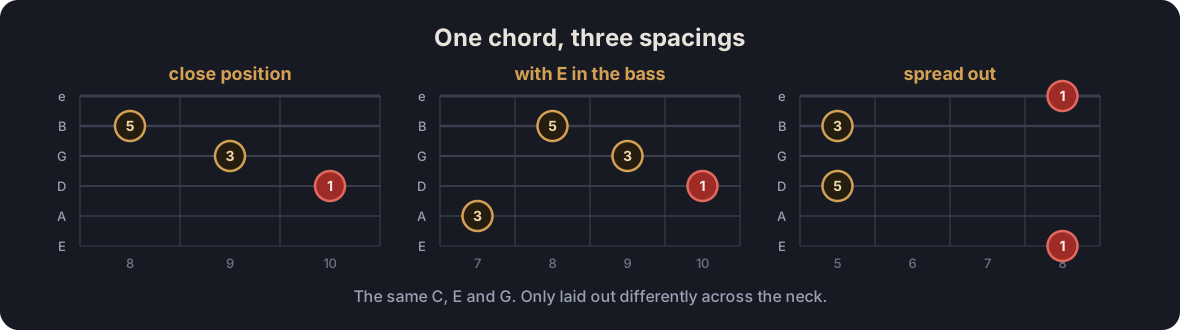
The point behind all this: a chord is not a fixed object to be memorised, it is a selection of intervals around a root note, and you can make that selection yourself. It is still worth looking at which combinations already have a name and how they sound, so you are not starting from nothing. But the fear of “a thousand chords I have to learn by heart” disappears once this is clear: it is always the same 12 notes and the same 12 intervals, just put together differently.
Which seven chords belong to a key, and why, is in the article on the major scale.
In short
- A triad is 1, 3 and 5. Whether it sounds major, minor, diminished or augmented depends on two switches only: 3 or ♭3, and 5 or ♭5 or ♯5.
- A fourth degree, the 7, turns it into a seventh chord. ♭7 or 7 work differently depending on the underlying chord, from tense (dominant seventh) to elegant and floating (maj7).
- Sus chords replace the 3 with the 2 or the 4, which leaves them neither major nor minor.
- Chord tones can also be chosen downwards (a different bass note) or spread across several octaves (voicing). The chord stays the same; its effect changes.
- A chord is a selection of intervals, not a fixed list of shapes to memorise.
- Intervals: the 12 feelings between two notes → Why an interval tells you more than a half step, how the bright and the dark version sound, and where all 12 sit inside one octave.
- How many notes are there, actually? The starting point before scales and chords → There are only 12 notes, and every song is a selection from them. Where scales, chords and melodies come from, before you touch a single shape.
- The major scale on guitar: the measure for everything else → The major scale built from intervals: why it is the measure for everything else, where the three positions sit, which chords come out of it.
More about this module: Share & learn together → Related tutorial: How do you build a chord progression and practise it on the fretboard? →
← How many notes are there, actually? The starting point before scales and chords