Basics
How many notes are there, actually? The starting point before scales and chords
SMART FRET Team ·
Before throwing yourself at scales and chords, there is a question worth asking that almost nobody does: what is this stuff, and how does it fit together? As in a kitchen, a recipe is easier to learn once you know what the individual ingredients are. Most guides start in the middle of the kitchen, straight at the scales. Musically that is correct, but as a starting point it is the wrong one. Here is the right one.
There are only 12 notes
With millions of songs released it sounds unbelievable, but music gets by on remarkably little material: there are only 12 notes. Those 12 repeat, over and over, endlessly upwards and downwards.
Picture a spiral staircase running off into the distance in both directions. That staircase really consists of only 12 steps, repeating constantly. Those 12 steps are the 12 notes, from the lowest note you can hear, something like the sub-bass outside a club at around 30 Hz, up to a thin high whistle at about 18,000 Hz.
From the side
From above
Which means: wherever you stand on that staircase, go twelve steps up or down and you land on the same note again. The steps have names: C, C#/Db, D, D#/Eb, E, F, F#/Gb, G, G#/Ab, A, A#/Bb, B, then C again. Some names appear twice, and C# and Db are the same note. That is easier to hear than to read, and on the staircase above you can click it.
Music is limitation: 12 notes, but not all at once
Every song you have ever heard is, at heart, nothing but a decision: which of these 12 notes am I choosing? Think of it as a palette with 12 colours. Use all 12 in one painting and it turns wild, every colour unfiltered. Aim to capture a particular emotion instead and you might pick only blue, grey and pink.
That is exactly what a scale does. It says: I have 12 notes available, I choose a particular selection of them, usually seven, and that selection has its own rhythm of small and larger gaps. That is what the next articles are about, when we build major and minor properly.
From the side
Root note
Why this limitation in particular? Because when we listen, our brain finds the gaps between the notes pleasant. A selection that does not allow everything creates tension, expectation, a sense of “this is happy now, or sad”. That is why the pentatonic, a scale with five notes instead of seven, sounds so reliably good: it limits harder still.
Foreground and background: chord and melody are the same material
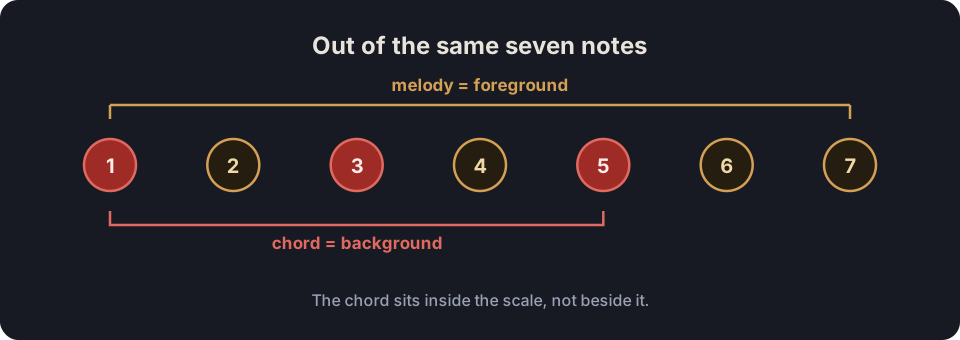
When you paint a picture, you need a background and something standing in front of it. In music the chord is the background and the melody the foreground, the brushstrokes that go over it. Both come out of the same selection of seven notes, and only the amount played at once differs.
Those seven notes become a chord when you focus on three of them: the 1, the 3 and the 5. Those three largely decide whether something sounds happy or sad (that is the 3), and the 5 gives the whole thing its solid ground. Everything you play on top of that, the 2, 4, 6 and 7, is melody over that background.
This is why so many guitarists treat chords and scales as two separate worlds, although they are made of the same material. A melody uses the intervals 1 through 7, a chord uses 1, 3 and 5. The same seven notes, one narrower selection and one wider. The chord sits inside the scale, not beside it. How every chord type falls out of that is in the article on chords.
Why a single note says nothing
A single note has no feeling yet. Only in relation to another note does one appear, and that relationship is called an interval. Because there are 12 notes, there are also 12 possible intervals: 12 different feelings a second note can create against a first. Some of them sound bright, some dark.
Exactly how is the subject of the next article. But it is worth knowing already: intervals, not half steps and whole steps, are the real blueprint behind why a scale or a chord sounds the way it does.
Music changes over time, the way a film is made of scenes
A painting you look at holds still. A song does not. As a film consists of several images in sequence, a song consists of several chords in sequence, each of them a brief emotional moment, a scene. Change the order of the chords and the whole picture changes, exactly as it does when a film is recut. Some songs stay in one scene for a long time, others move quickly.
This is why you can write an unlimited number of different songs with the same 12 notes. It is not only about which notes you choose, but also about the order they come in and how long you stay on each one.
In short
- There are only 12 notes. They repeat endlessly upwards and downwards, like a spiral staircase with 12 steps.
- Music is always a selection from those 12 notes, usually seven of them. That is a scale.
- Chord (background, usually the notes 1-3-5) and melody (foreground, all seven notes) come from the same selection. Two perspectives on one material, not two subjects.
- A single note has no feeling. Only the distance between two notes, the interval, creates one.
- A song is several chords in sequence, the way a film is a sequence of scenes. Order and dwell time shape the effect at least as much as the choice of notes.
- Intervals: the 12 feelings between two notes → Why an interval tells you more than a half step, how the bright and the dark version sound, and where all 12 sit inside one octave.
- Chords: how intervals turn into a background → Major, minor, diminished, augmented and the sevenths come out of two switches. Know the intervals and you stop collecting shapes.
- The major scale on guitar: the measure for everything else → The major scale built from intervals: why it is the measure for everything else, where the three positions sit, which chords come out of it.
- The minor scale on guitar: the same notes, a different root → Natural minor has the same notes as its relative major. Which interval tips over, where the positions sit, and what harmonic minor is for.
- The minor pentatonic on guitar: five positions across the whole neck → The minor pentatonic is the minor chord plus two notes. Why the 2 and the ♭6 are missing, where the five positions sit and how to practise.
More about this module: One fretboard for every instrument → Related tutorial: How do scales, chords and modes connect? →