Basics
Intervals: the 12 feelings between two notes
SMART FRET Team ·
A single note sets nothing off. Only in relation to a second one does a feeling appear, and that relationship is called an interval. Because there are 12 notes, there are exactly 12 intervals: 12 possible distances one note can have to another, and each of them sounds different.
Once you have understood these 12, you have also understood why major sounds bright and minor dark, why a chord feels stable or unstable, and why a scale carries a particular mood at all. Scales are, in the end, nothing but a selection from exactly these 12 intervals.
Why intervals matter more than half steps and whole steps
Most explanations of scales work with half steps and whole steps, that is, with the distance from one note to the next. That is technically correct, but it does not answer the real question. A half step tells you how far apart two neighbouring notes are. An interval tells you how a note stands in relation to your root note, and it is that relationship that creates a feeling.
So it pays to think from the root note outwards, not from note to note. When you are standing on a note, say C, each of the other 11 notes has its own fixed relationship to you. That relationship does not change whichever root note you pick. The 3 always sounds equally bright, whether it is counted from C or from G.
The party metaphor: every note experiences you differently
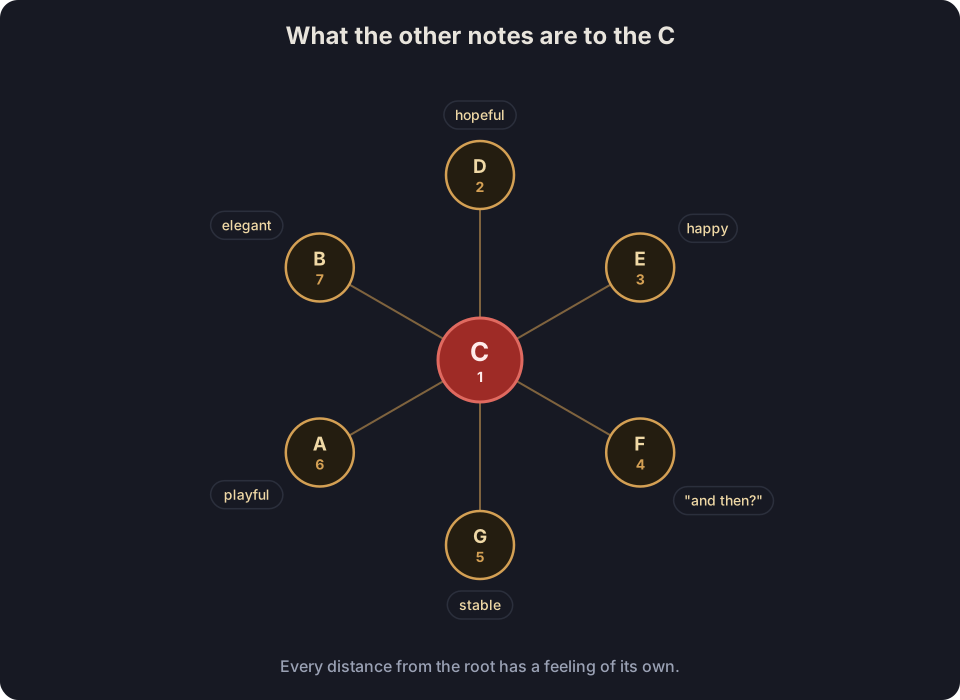
Imagine you are the note C, throwing a party. D, E, F, G, A and B all turn up. You get on especially well with E and G, your 3 and your 5, and together you make a cheerful C major chord. From your perspective, mind you: to you the E feels bright and the G feels stable, and the whole party comes across as happy.
But every guest experiences the same party differently. To the G, you, the C, are its fifth, and that feels stable to G as well. To the B, on the other hand, you are not a chord tone at all, you are just happening to be there, and that feels like friction, unresolved. So every note has its own 3 and its own 5, depending on who is the root at the time. That is why one and the same note can sound stable in one chord and restless in the next: it has simply changed parties.
Seven bright intervals, five dark, though not absolutely
Of the 12 intervals, seven count as broadly bright and five as broadly dark. You cannot say it absolutely, because it always depends on context, but as a rule of thumb it works well. The major scale (1-2-3-4-5-6-7) consists entirely of the bright versions, which is why it sounds so friendly overall.
The decisive part: most of these intervals come in two versions, a large, bright one and a small, dark one, marked in notation with a ♭ for “lowered”. And that ♭ version almost always does the opposite of the original.
| Interval | The bright version sounds … | The dark (♭) version sounds … |
|---|---|---|
| 2 | hopeful | like “game over”, the exact opposite of hope |
| 3 | happy | sad |
| 5 | stable, grounded | unstable, tipping |
| 6 | playful | strict, authoritarian |
| 7 | elegant (over a major chord) | blunt, raw |
The 3 is what decides most strongly whether we are in a major or a minor feeling. It is the note our ear judges first. The 5 gives the whole thing its ground. Together, 1, 3 and 5 are the basis of every chord, and there is more on that in the next article.
Finding all 12 intervals inside one octave: the A shape as an example
Theory is one thing. On the guitar you want to know where these intervals actually sit. You do not have to memorise the whole neck for that. A single octave is enough, because all 12 intervals lie inside it. The pattern repeats everywhere on the neck.
Take the A shape as the example. The root note sits on the A string, its octave on the G string two frets further right, towards the body. Between those two points you find every interval in a small space:
- A string: 1, ♭2, 2, ♭3, fret by fret to the right from the root
- D string: 3, 4, ♭5, 5, ♭6, starting one fret left of the root
- G string: 6, ♭7, 7 and finally the octave, the new 1
Choose an interval
The root note is the C at the 3rd fret of the A string.
Play each interval together with the root note and listen closely: the opposing pairs from the table above sit right next to each other here. One single fret separates the ♭3 and the 3. The same goes for the ♭5 and the 5. That is how “one fret apart” becomes an audible difference between sad and happy, or between unstable and grounded.
This works with every octave on the guitar
The A shape is only our example. The guitar has several octave shapes, and each of them holds the same 12 intervals, only distributed differently across the strings:
- low E string to D string: octave two frets right, the same picture as in the A shape, one string lower
- D string to B string: octave three frets right
- G string to high E string: octave three frets right
As soon as the B string is involved, the pattern shifts by one fret. That comes from the tuning: between the G and B strings there is a major third instead of a fourth. The intervals themselves do not change, only their place on the fretboard. So anyone who really knows one octave learns the others by comparison rather than by memorising.
How 12 intervals become 12 keys
If you run the same thought experiment not only from C but from each of the 12 notes, you get what music calls a key. The distances, the intervals, stay exactly the same throughout, and only the starting point moves. That is why “Happy Birthday” can be sung from any note at all: the melody stays identical in its intervals, and only the first step on the spiral staircase is a different one.
It is also the reason a guitar shape simply moves. Because an interval always measures the same number of frets regardless of the root note, the same fingering at any point on the neck gives you a different key, but the same set of intervals and therefore the same feeling.
In short
- An interval is the distance between two notes, and it is that distance, not the single note, that creates a feeling.
- There are 12 intervals because there are 12 notes. Seven count roughly as bright, five as dark.
- Every note in a chord has its own perspective: what is the 3 or the 5 to the root is something quite different to another note.
- Most intervals have a bright and a dark (♭) version, and the dark one almost always does the opposite: 3 against ♭3, 5 against ♭5, and so on.
- All 12 intervals sit inside a single octave on the fretboard. In the A shape the A, D and G strings are enough.
- The same 12 intervals, thought from each of the 12 notes, give you the 12 keys. That is why every shape on the guitar moves.
- How many notes are there, actually? The starting point before scales and chords → There are only 12 notes, and every song is a selection from them. Where scales, chords and melodies come from, before you touch a single shape.
- Chords: how intervals turn into a background → Major, minor, diminished, augmented and the sevenths come out of two switches. Know the intervals and you stop collecting shapes.
- The major scale on guitar: the measure for everything else → The major scale built from intervals: why it is the measure for everything else, where the three positions sit, which chords come out of it.
More about this module: One fretboard for every instrument → Related tutorial: How do scales, chords and modes connect? →
← How many notes are there, actually? The starting point before scales and chords